

 1049 Kundenrezensionen
 Von der kostenlosen Demo bis zur 365-tägigen Update-Garantie begleitet Sie EchteFrage durch die gesamte Vorbereitung auf die PECB Certified ISO/IEC 27005 Risk Manager. Starten Sie 2026 mit den 62 Übungsfragen zur ISO-IEC-27005-Risk-Manager Prüfung.
PECB ISO-IEC-27005-Risk-Manager Prüfungsübersicht:
| Zertifizierungsanbieter: | PECB () |
|---|---|
| Prüfungsname: | Prüfung zum PECB-zertifizierten ISO/IEC 27005 Risikomanager |
| Prüfungsnummer: | ISO-IEC-27005-Risk-Manager |
| Verfügbare Sprachen: | Arabisch, Englisch, Spanisch, Französisch, Portugiesisch |
| Mindestpunktzahl: | 70% |
| Prüfungsdauer: | 120-180 |
| Prüfungsgebühr: | Unterscheidet sich je nach Region (üblicherweise im Bereich von 500–1000 USD, keine offizielle Festlegung) |
| Prüfungsformat: | Prüfung ohne Hilfsmittel, Multiple-Choice-Fragen |
| Gültigkeitsdauer des Zertifikats: | 3 Jahre |
| Verwandte Zertifizierungen: | ISO/IEC 27001 Leitender Implementierer ISO/IEC 27001 Leitender Auditor ISO/IEC 27005 Risikomanager |
| Anzahl der Fragen: | 80 |
| Empfohlenes Training: | PECB-Schulung zum ISO/IEC 27005 Risikomanager |
| Prüfungsanmeldung: | Offizielles PECB-Portal für Zertifizierungen |
| Beispielfragen: |  |
| Prüfungsmethode: | Online-Prüfung oder Vor-Ort-Prüfung mit Aufsicht |
| Voraussetzungen: | Keine zwingenden Teilnahmevoraussetzungen, jedoch werden Kenntnisse zu ISO/IEC 27001 und dem Informationssicherheitsmanagement dringend empfohlen |
| Offizielle Syllabus-URL: | https://pecb.com |
PECB ISO-IEC-27005-Risk-Manager Prüfungsthemen:
| Abschnitt | Ziele |
|---|---|
| Thema 1: Risikobehandlung und Auswahl von Kontrollmaßnahmen | - Strategien zur Risikominderung - Auswahl und Umsetzung von Kontrollmaßnahmen |
| Thema 2: Rahmenwerk ISO/IEC 27005 | - Prozess der Risikobewertung - Festlegung des Kontexts - Maßnahmen zur Risikobehandlung |
| Thema 3: Risikokommunikation und Überwachung | - Risikoberichterstattung und Kommunikation - Fortlaufende Überwachung und Überprüfung |
| Thema 4: Grundsätze des Informationssicherheits-Risikomanagements | - Grundlagen des Risikomanagements - Risikobegriffe und Fachterminologie |
| Thema 5: Methoden der Risikobewertung | - Quantitative Risikoanalyse - Qualitative Risikoanalyse |
ISO-IEC-27005-Risk-Manager Prüfungs-FAQ: Ihre Fragen, unsere Antworten
Die ISO-IEC-27005-Risk-Manager Prüfung (PECB Certified ISO/IEC 27005 Risk Manager) ist eine offizielle Zertifizierungsprüfung von PECB. Mit dem Bestehen erlangen Sie die Zertifizierung PECB-zertifizierter ISO/IEC 27005 Risikomanager. Sie ist der Stufe Fachkraft zugeordnet. In engem Zusammenhang stehen außerdem die Zertifizierungen ISO/IEC 27001 Leitender Implementierer, ISO/IEC 27001 Leitender Auditor, ISO/IEC 27005 Risikomanager.
Die ISO-IEC-27005-Risk-Manager Prüfung umfasst 80 Fragen in 120-180. Daraus ergibt sich ein straffes Antworttempo: Verlieren Sie sich nicht zu lange in einzelnen Fragen, markieren Sie unsichere Punkte und behalten Sie am Ende eine Zeitreserve für den zweiten Durchgang. Am wirksamsten trainieren Sie dieses Zeitmanagement, indem Sie die 62 Übungsfragen von EchteFrage mehrfach unter realen Zeitbedingungen durcharbeiten – die Desktop- und die Online Test Engine begleiten Sie dabei mit einem Zeitlimit wie im Prüfungszentrum.
Welche Punktzahl brauche ich zum Bestehen der ISO-IEC-27005-Risk-Manager Prüfung und was kostet sie?
Zum Bestehen der ISO-IEC-27005-Risk-Manager Prüfung benötigen Sie 70%. Die offizielle Prüfungsgebühr beträgt Unterscheidet sich je nach Region (üblicherweise im Bereich von 500–1000 USD, keine offizielle Festlegung); beachten Sie, dass bei einem Nichtbestehen der volle Betrag für jeden Wiederholungsversuch erneut anfällt. Messen Sie daher Ihren Wissensstand vor der Anmeldung mit den Übungsfragen von EchteFrage: Liegen Ihre Ergebnisse in den Übungstests stabil über der Bestehensgrenze, ist der Prüfungstermin eine gut investierte Entscheidung.
Für die ISO-IEC-27005-Risk-Manager Prüfung gilt: Keine zwingenden Teilnahmevoraussetzungen, jedoch werden Kenntnisse zu ISO/IEC 27001 und dem Informationssicherheitsmanagement dringend empfohlen Da Hersteller ihre Zulassungsbedingungen gelegentlich anpassen, bestätigen Sie die aktuellen Vorgaben bitte vor der Anmeldung auf der offiziellen Seite von PECB: Offizielle Prüfungsinformationen zur PECB Certified ISO/IEC 27005 Risk Manager.
Die Anmeldung zur ISO-IEC-27005-Risk-Manager Prüfung erfolgt über die folgenden offiziellen Kanäle:
Zur Prüfungsform: Online-Prüfung oder Vor-Ort-Prüfung mit Aufsicht
PECB empfiehlt zur Vorbereitung auf die PECB Certified ISO/IEC 27005 Risk Manager die folgenden offiziellen Trainings:
Ergänzend dazu bieten Ihnen die 62 Übungsfragen von EchteFrage die Möglichkeit, das Gelernte unter Prüfungsbedingungen anzuwenden und Wissenslücken gezielt zu schließen.
Ja. Laden Sie einfach die kostenlose PDF-Demo zur ISO-IEC-27005-Risk-Manager Prüfung herunter und prüfen Sie Qualität und Schwierigkeitsgrad der Fragen, bevor Sie sich entscheiden. Nach dem Kauf erhalten Sie außerdem 365 Tage lang kostenlose Updates: Sobald sich die Prüfungsinhalte ändern, sendet Ihnen EchteFrage die aktualisierte Version automatisch per E-Mail. Nach Ablauf des Jahres verlängern Sie den Update-Service mit 50 % Rabatt.
Sollten Sie die entsprechende Prüfung innerhalb von 60 Tagen nach dem Kauf nicht bestehen, erstatten wir Ihnen den Kaufpreis vollständig (100% Money Back Guarantee). Voraussetzungen: Die Prüfung wurde frühestens drei Tage nach dem Kauf abgelegt, der Name des Prüflings stimmt mit dem des Zahlenden überein, und Sie reichen innerhalb von zwei Tagen nach der Prüfung die Anmeldebestätigung (Enrollment Slip) als Scan sowie das offizielle Score Report als PDF ein – die Bearbeitung erfolgt innerhalb von sieben Tagen. Ausgenommen sind kostenlose Materialien und abgelaufene Bestellungen. Alternativ zur Rückerstattung können Sie kostenlos zwei gleichwertige Prüfungsvorbereitungen wählen und behalten dabei den Update-Service Ihres gekauften Produkts. Die Lieferung erfolgt unmittelbar nach Zahlungseingang als Sofort-Download: Ihre Unterlagen erreichen Sie innerhalb einer Minute per E-Mail; sollte die Nachricht nach zwei Stunden noch nicht eingegangen sein, wenden Sie sich bitte an unseren Kundendienst. Eine Begrenzung der Installationen auf verschiedenen Computern gibt es nicht.
Die ISO-IEC-27005-Risk-Manager Prüfung gliedert sich in 5 Themenbereiche. Zu den wichtigsten zählen:
- Rahmenwerk ISO/IEC 27005
- Methoden der Risikobewertung
- Grundsätze des Informationssicherheits-Risikomanagements
Die vollständige Aufstellung aller Bereiche samt Gewichtung finden Sie in der Prüfungsübersicht weiter oben auf dieser Seite.
PECB Certified ISO/IEC 27005 Risk Manager ISO-IEC-27005-Risk-Manager Prüfungsfragen mit Lösungen
Frage #1
Scenario 8: Biotide is a pharmaceutical company that produces medication for treating different kinds of diseases. The company was founded in 1997, and since then it has contributed in solving some of the most challenging healthcare issues.
As a pharmaceutical company, Biotide operates in an environment associated with complex risks. As such, the company focuses on risk management strategies that ensure the effective management of risks to develop high-quality medication. With the large amount of sensitive information generated from the company, managing information security risks is certainly an important part of the overall risk management process. Biotide utilizes a publicly available methodology for conducting risk assessment related to information assets. This methodology helps Biotide to perform risk assessment by taking into account its objectives and mission. Following this method, the risk management process is organized into four activity areas, each of them involving a set of activities, as provided below.
1. Activity area 1: The organization determines the criteria against which the effects of a risk occurring can be evaluated. In addition, the impacts of risks are also defined.
2. Activity area 2: The purpose of the second activity area is to create information asset profiles. The organization identifies critical information assets, their owners, as well as the security requirements for those assets. After determining the security requirements, the organization prioritizes them. In addition, the organization identifies the systems that store, transmit, or process information.
3. Activity area 3: The organization identifies the areas of concern which initiates the risk identification process. In addition, the organization analyzes and determines the probability of the occurrence of possible threat scenarios.
4. Activity area 4: The organization identifies and evaluates the risks. In addition, the criteria specified in activity area 1 is reviewed and the consequences of the areas of concerns are evaluated. Lastly, the level of identified risks is determined.
The table below provides an example of how Biotide assesses the risks related to its information assets following this methodology:
Based on the scenario above, answer the following question: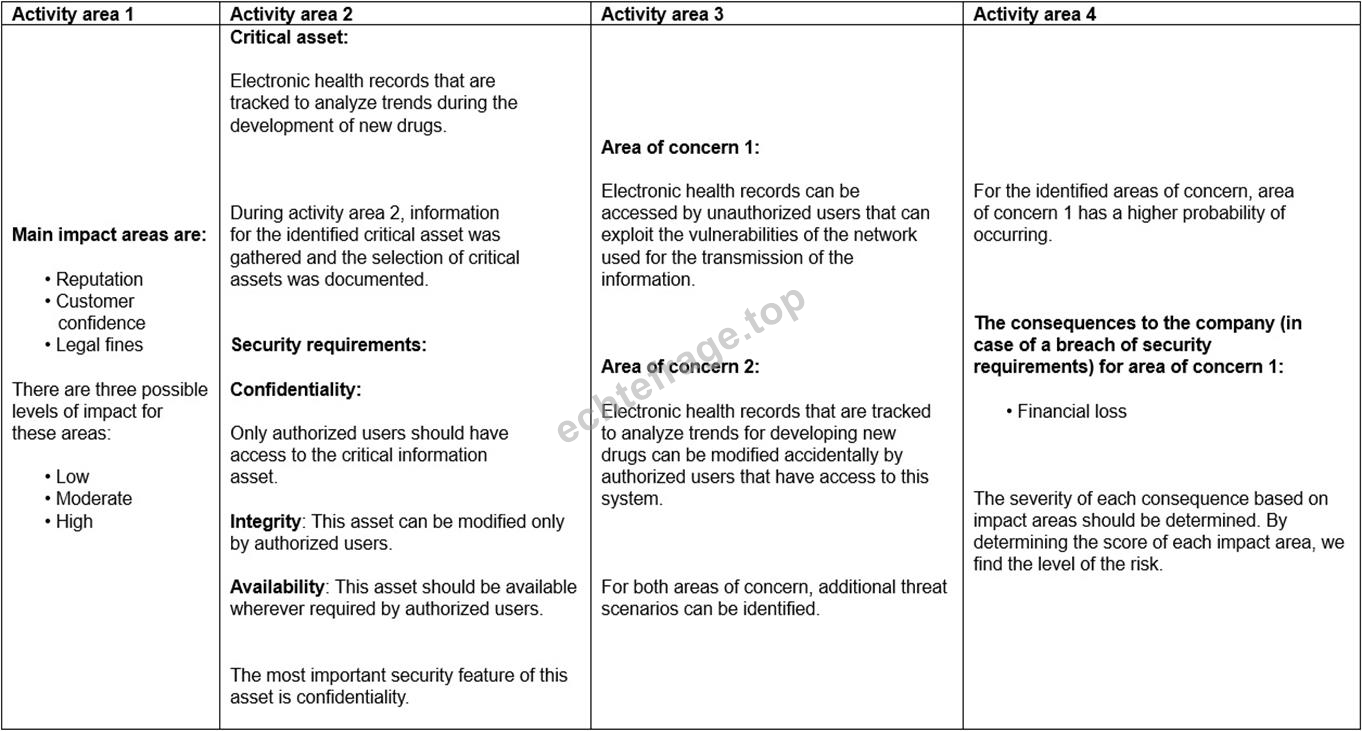
Which risk assessment methodology does Biotide use?
A. OCTAVE Allegro
B. MEHARI
C. OCTAVE-S
Frage #2
Which statement regarding risks and opportunities is correct?
A. Opportunities might have a positive impact, whereas risks might have a negative impact
B. Risks always have a positive outcome whereas opportunities have an unpredicted outcome
C. There is no difference between opportunities and risks; these terms can be used interchangeably
Frage #3
Scenario 1
The risk assessment process was led by Henry, Bontton's risk manager. The first step that Henry took was identifying the company's assets. Afterward, Henry created various potential incident scenarios. One of the main concerns regarding the use of the application was the possibility of being targeted by cyber attackers, as a great number of organizations were experiencing cyberattacks during that time. After analyzing the identified risks, Henry evaluated them and concluded that new controls must be implemented if the company wants to use the application. Among others, he stated that training should be provided to personnel regarding the use of the application and that awareness sessions should be conducted regarding the importance of protecting customers' personal data.
Lastly, Henry communicated the risk assessment results to the top management. They decided that the application will be used only after treating the identified risks.
According to scenario 1, what type of controls did Henry suggest?
A. Administrative
B. Managerial
C. Technical
Frage #4
Scenario 1
The risk assessment process was led by Henry, Bontton's risk manager. The first step that Henry took was identifying the company's assets. Afterward, Henry created various potential incident scenarios. One of the main concerns regarding the use of the application was the possibility of being targeted by cyber attackers, as a great number of organizations were experiencing cyberattacks during that time. After analyzing the identified risks, Henry evaluated them and concluded that new controls must be implemented if the company wants to use the application. Among others, he stated that training should be provided to personnel regarding the use of the application and that awareness sessions should be conducted regarding the importance of protecting customers' personal data.
Lastly, Henry communicated the risk assessment results to the top management. They decided that the application will be used only after treating the identified risks.
According to scenario 1, Bontton wanted to use an application that ensures only authorized users have access to customers' personal dat a. Which information security principle does Bontton want to ensure in this case?
A. Confidentiality
B. Integrity
C. Availability
Frage #5
Scenario 4: In 2017, seeing that millions of people turned to online shopping, Ed and James Cordon founded the online marketplace for footwear called Poshoe. In the past, purchasing pre-owned designer shoes online was not a pleasant experience because of unattractive pictures and an inability to ascertain the products' authenticity. However, after Poshoe's establishment, each product was well advertised and certified as authentic before being offered to clients. This increased the customers' confidence and trust in Poshoe's products and services. Poshoe has approximately four million users and its mission is to dominate the second-hand sneaker market and become a multi-billion dollar company.
Due to the significant increase of daily online buyers, Poshoe's top management decided to adopt a big data analytics tool that could help the company effectively handle, store, and analyze dat a. Before initiating the implementation process, they decided to conduct a risk assessment. Initially, the company identified its assets, threats, and vulnerabilities associated with its information systems. In terms of assets, the company identified the information that was vital to the achievement of the organization's mission and objectives. During this phase, the company also detected a rootkit in their software, through which an attacker could remotely access Poshoe's systems and acquire sensitive data.
The company discovered that the rootkit had been installed by an attacker who had gained administrator access. As a result, the attacker was able to obtain the customers' personal data after they purchased a product from Poshoe. Luckily, the company was able to execute some scans from the target device and gain greater visibility into their software's settings in order to identify the vulnerability of the system.
The company initially used the qualitative risk analysis technique to assess the consequences and the likelihood and to determine the level of risk. The company defined the likelihood of risk as "a few times in two years with the probability of 1 to 3 times per year." Later, it was decided that they would use a quantitative risk analysis methodology since it would provide additional information on this major risk. Lastly, the top management decided to treat the risk immediately as it could expose the company to other issues. In addition, it was communicated to their employees that they should update, secure, and back up Poshoe's software in order to protect customers' personal information and prevent unauthorized access from attackers.
According to scenario 4, Poshoe has identified its assets, vulnerabilities, and threats associated with its information systems. What does the company need in order to start identifying its existing controls?
A. The risk treatment implementation plan and documentation of controls
B. A list of incident scenarios with their consequences
C. A list of all existing and planned controls
Fragen und Antworten:
| Frage #1 Antwort: A | Frage #2 Antwort: A | Frage #3 Antwort: A | Frage #4 Antwort: A | Frage #5 Antwort: C |














Funk -
Meiner Meinung nach ist dises Lernmaterial sehr gut. Es ist gut geschrieben und leicht zu verstehen. Ich habe in der letzten Woche die Prüfung ISO-IEC-27005-Risk-Manager bestanden. Wenn Sie gute Studienmaterial für die Zertifizierungsprüfung noch suchen, ist es eine gute Alternative.